





Make the flap
A microkeratome creates a flap about 160 micrometers thick on the upper cornea. It shields the epithelial cells and Bowman's membrane.
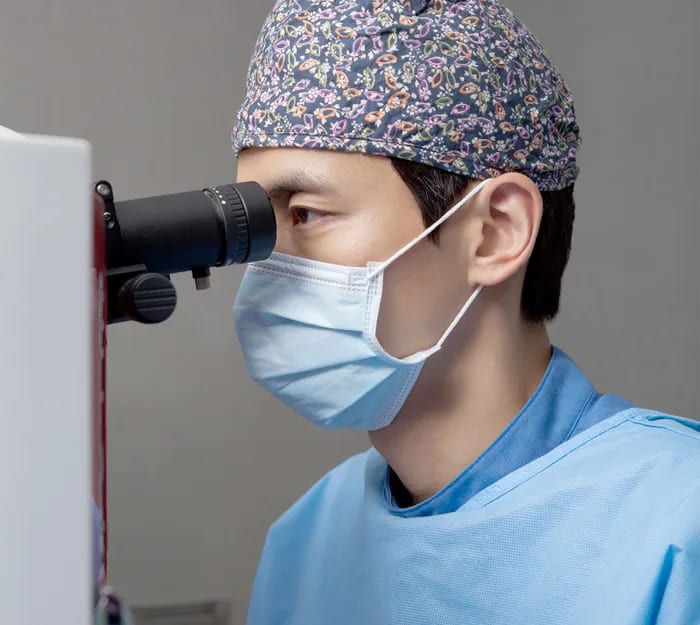
A thin flap, a short recovery
LASIK eye surgery in South Korea, as at Sky Eye Clinic in Seoul, corrects myopia, astigmatism and hyperopia by lifting a thin corneal flap, reshaping the tissue beneath with a laser, and laying the flap back down.
Because the surface cells stay protected under the flap, recovery is short. At Sky Eye Clinic it is performed with the Amaris Red SPT laser and Co-Wave customization.
LASIK means laser in-situ keratomileusis. It is performed worldwide and is known for stable, predictable results. Numbing drops are the only anesthesia.
A microkeratome creates a flap about 160 micrometers thick on the upper cornea. It shields the epithelial cells and Bowman's membrane.
The flap is turned back to expose the corneal stroma.
The laser reshapes the stroma to correct your refractive error.
The flap returns to its original position.
If that applies to you, read LASEK and New SMILE LASIK.
| LASIK | LASEK | New SMILE LASIK | |
|---|---|---|---|
| Method | Thin flap, laser on the stroma | Epithelium removed, laser on the stroma | 2mm micro-incision, tissue removed, no flap |
| Thin cornea | May not suit; LASEK-type advised | Suitable when LASIK leaves too little cornea | Listed for high myopia with thin corneas |
| Early discomfort | About half a day | Up to 3 to 4 days; blurring 5 to 7 days | Minimal corneal damage |
| Flap | Flap-related complications possible | No flap; epithelium regrows under a protective lens | No flap, so no flap complications |
The Amaris Red laser fires at 1050Hz and ablates in under 1.3 seconds per diopter. It tracks the eye in 7 dimensions, measures corneal thickness in real time and uses a 0.54mm spot. Smart Pulse Technology (SPT) smooths the treated surface to support recovery and visual quality.
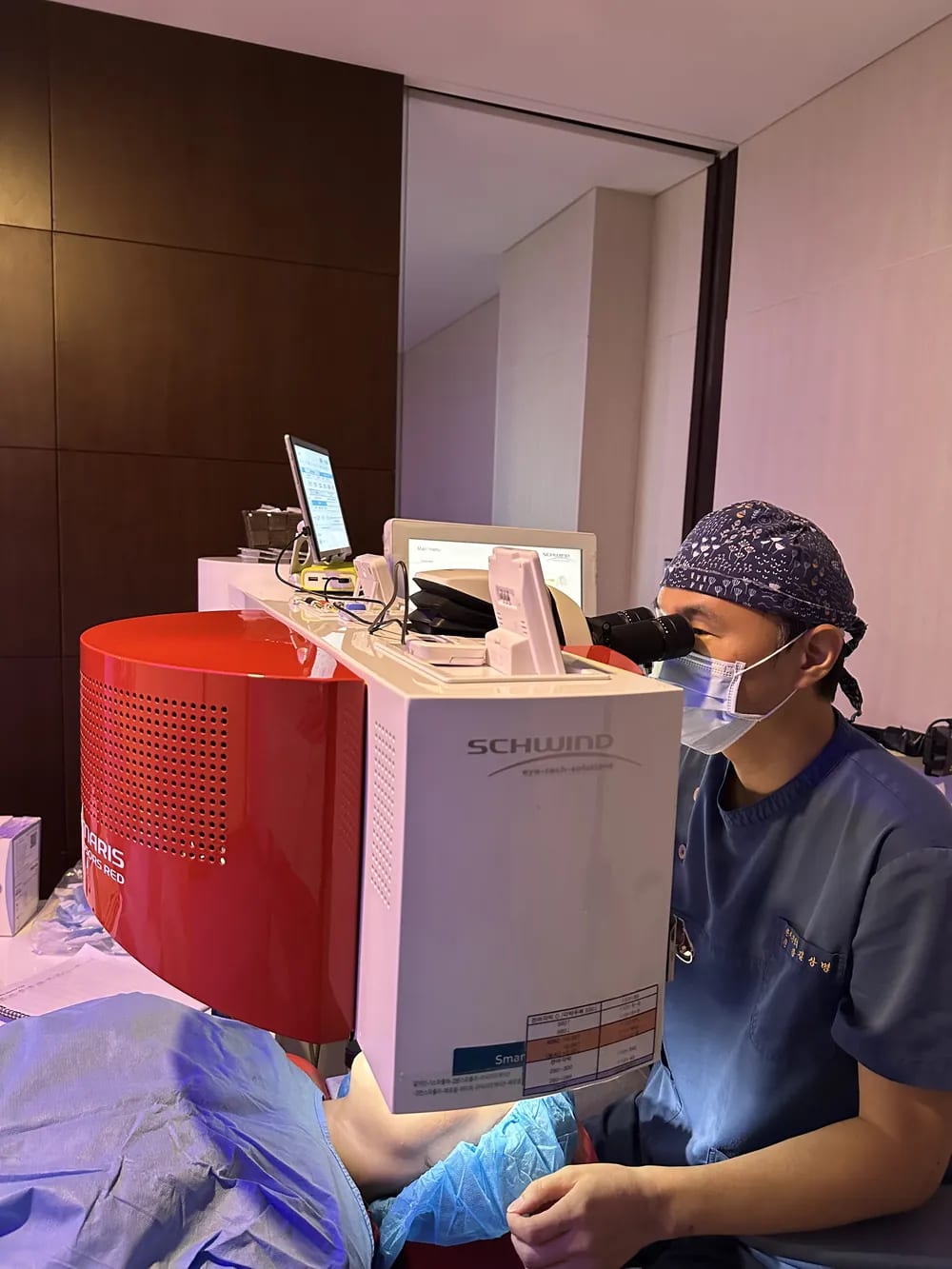
A wavefront exam finds high-order aberrations, and the treatment smooths the corneal surface accordingly. Your data travels to the operating room on a personal memory chip. The clinic says it suits high myopia with astigmatism, presbyopia correction over 40, asymmetric corneal topography and high-order aberrations.
A cornea thinned by surgery can be strengthened with corneal cross-linking. Lasers are listed on the equipment page.
Fees are listed under LASIK cost in Korea. For international patients, the clinic lists fees at 49% off the regular rate, the same fee Korean patients pay, and adds a free MRI precision exam (worth KRW 100,000) and free autologous serum eye drops (worth KRW 200,000).
About 160 micrometers. A microkeratome makes it on the upper cornea, and it is repositioned after the laser.
Adults 18 or older with a prescription stable for a year, approved by a doctor after a full exam. It helps most if glasses or lenses are a struggle for you.
Numbing drops are used. On the day you may feel irritation, tearing and grittiness, which usually lasts about half a day after LASIK.
Below a certain thickness, a LASEK-type surgery that keeps the most residual cornea is recommended instead.