





A cornea that thins and bulges
Part of the cornea becomes abnormally thin and pushes forward into a cone. The result is irregular astigmatism and blurred vision that glasses cannot put right.

Four ways to treat a cornea that is changing shape
Keratoconus is treated with cross-linking, corneal rings, special contact lenses or, as a last step, a transplant. Which one fits depends on how thick your cornea still is.
Because the cornea thins and bulges into a cone, glasses cannot fully correct the vision it produces. That is why Sky Eye Clinic in Seoul starts with an accurate diagnosis.
Part of the cornea becomes abnormally thin and pushes forward into a cone. The result is irregular astigmatism and blurred vision that glasses cannot put right.
Keratoconus is progressive, so an early assessment matters. It is also why the cornea is screened carefully before any laser surgery such as LASIK or New SMILE LASIK.
Rubbing sends repeated shocks through the cornea and can speed the disease up. Leaving your eyes alone is one of the most important things you can do.
Sky Eye Clinic
A solution is absorbed into the stroma, rinsed off, and the cornea is then exposed to UVA light. This raises the bonding strength of the collagen and stiffens the cornea. It is only possible when the cornea is thick enough.
Combined with Co-Wave it can partly correct irregular astigmatism, and an ICL can follow about a month later. EVO+ Aqua ICL corrects vision with a lens inside the eye while the cornea is preserved. Full detail: corneal cross-linking.
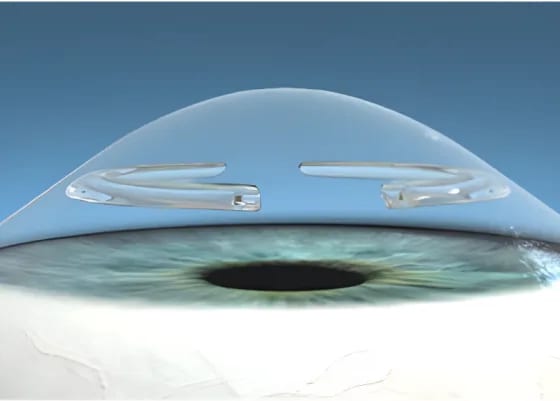
A semicircular ring is placed in the corneal stroma. It draws the bulging cornea outward and flattens it, easing the keratoconus and correcting myopia at the same time.
The cornea must not be too thin, so advanced disease can rule it out. For that reason rings are sometimes placed early.
Hard lenses fitted closely to the cornea suit early disease or a cornea that has stopped changing. They can slow progression to a degree and may give clearer vision than glasses.
Long wear can cause pain and a foreign body sensation, and fitting an irregular cornea has to be exact. If the disease keeps progressing, another method is needed.
The most traditional surgery, with a high success rate. Rejection, though, can cause problems for life, and recovery takes more than a year, so doctors hold it back as long as they can.
| Option | Typically used when | Main caution |
|---|---|---|
| Cross-linking | The cornea is thick enough | Not possible on a cornea that is too thin |
| Corneal ring | The cornea is not too thin, often early disease | May not be possible once advanced |
| Special contact lenses | Early disease or a stable cornea | Pain or foreign body sensation with long wear |
| Transplant | Other methods are not enough | Rejection risk; recovery over a year |
Your surgeon recommends an option only after measuring your cornea. The corneal topography devices used are listed on the equipment page.
Both genetic and environmental factors. Genetic research is ongoing. Frequent eye rubbing is the most common environmental factor, and contact lens wear and UV exposure are also listed.
No. Cross-linking, corneal rings and special contact lenses come first. A transplant is the most traditional surgery and is delayed as long as possible.
Only people whose cornea is thick enough. A corneal scan decides whether you qualify.
Each rub sends a shock through the cornea, and repeated shocks can make the disease progress faster.