





Registration
At the desk, staff confirm the booking you made online or by phone. No booking yet? They register you there.
Eleven steps to a decision, six on surgery day
A first visit runs through 11 steps: registration, a short interview, a series of eye tests, a counselor’s explanation and finally the doctor’s own exam. If you go ahead, surgery day has 6 more steps.
The clinic’s tour of a first visit is built around LASIK, but the same exam order applies to other vision correction. Knowing it in advance makes the day calmer.
Steps 1 to 3 get you registered and ready. Steps 4 to 9 are the tests. Steps 10 and 11 are where your results are explained.
At the desk, staff confirm the booking you made online or by phone. No booking yet? They register you there.
In the consultation room, staff go over the basics for your exam, including whether you have seen an eye doctor before and any conditions you already have.
You wait in the waiting room until the comprehensive exam is ready for you.
Measures your myopia and astigmatism, and the curvature radius of your cornea.
Raised pressure can be a sign of glaucoma, and readings shift after surgery, so this test is not skipped. The normal range is 10 to 20 mmHg. A higher reading leads to a detailed glaucoma exam.
Maps the curvature and shape of the corneal surface to find keratoconus or an irregular cornea.
A digital camera photographs the retina, the nerve layer at the back of the eye, so the optic nerve and retina can be checked.
More tests from the exam program analyse your eyes in detail to help plan the surgery.
Screens for Avellino corneal dystrophy. If the result is positive, surgery is not performed, for your safety.
A counselor walks you through your results, explains which vision correction option fits them and takes your questions.
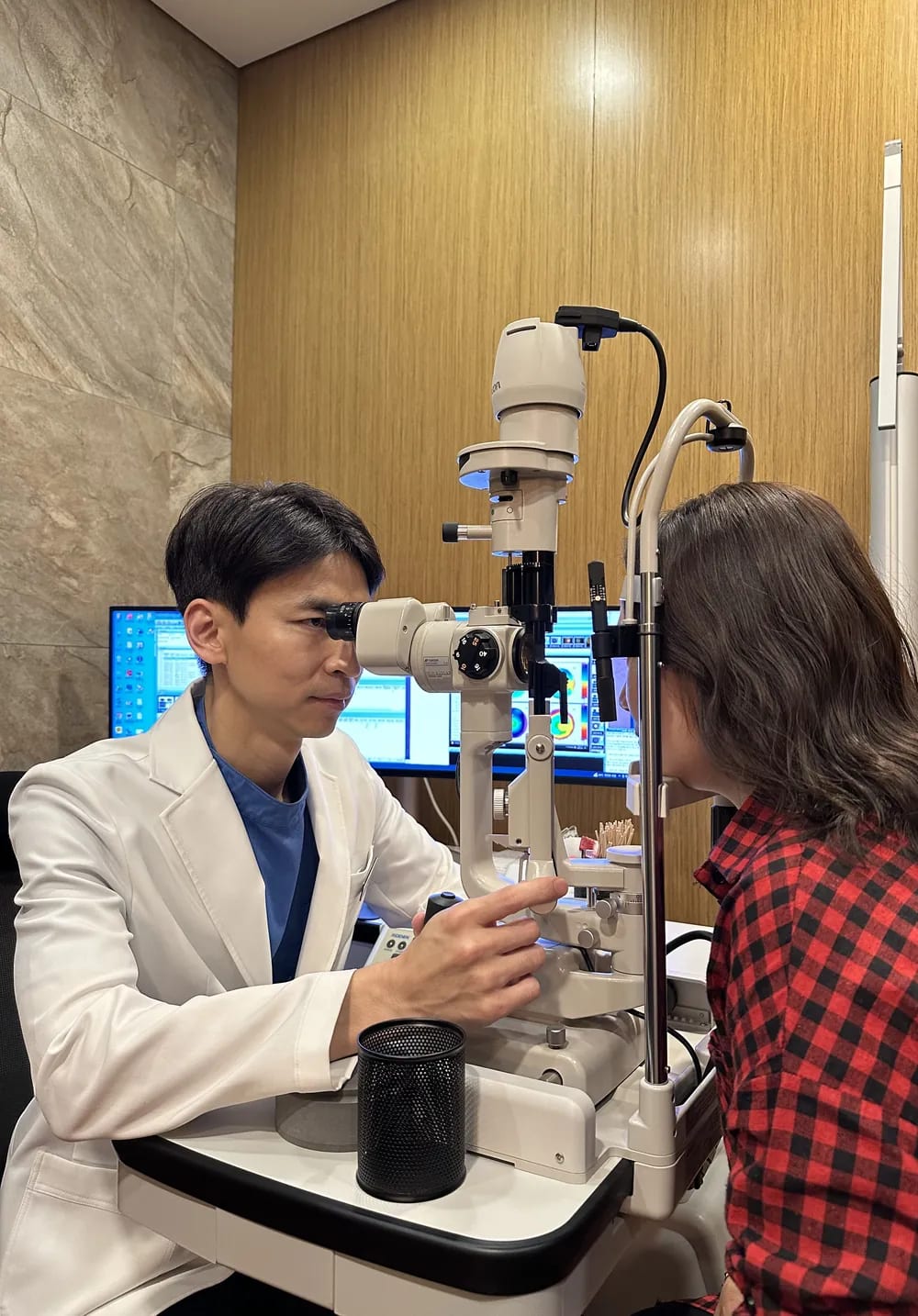
The doctor examines your eyes closely, including with a slit-lamp microscope, and holds the full pre-surgery consultation. If a result rules surgery out, you hear it here.
You are told in detail how to prepare and you sign the surgery consent form.
After cleansing and sterilisation the operation starts. It takes about 15 minutes, though this depends on the method.
The operation ends on the doctor’s instructions in the operating room, and staff take you to the recovery room.
You close your eyes and rest for a while.
The doctor examines your eyes and explains how the surgery went.
You learn how to look after your eyes, agree on follow-up appointments, ask anything left over, then go home.
The care rules for the days around your procedure are in the LASIK and LASEK pre and post-op guide. The tests above use the devices on the equipment page.
After registration, the short interview and a wait, the first test is auto-refraction. It measures myopia, astigmatism and corneal curvature.
No, it is optional. A positive result means surgery is avoided, for safety.
About 15 minutes, varying with the surgical method.
The clinic uses a normal range of 10 to 20 mmHg. Higher readings lead to a detailed glaucoma exam.